
Share this link via
Or copy link
Bet The Flip (β)
Your current points are 10.
Current win streak: 2
Win streak bonus: x1.5
Which one will you bet on?
How much would you like to bet?
You're betting 3 points on heads.
If you're ready, please tap the button below, and flip your coin!
Result
You Win! You've earned points!
Current points: 10

Should I pick heads or tails? Science actually has an answer. In the largest coin-flip experiment ever run — 350,757 real tosses — the coin landed on the same side it started on 50.8% of the time. The toss isn't perfectly 50/50, and the reasons why are worth knowing before you call your next flip.
In a perfect world, the odds are exactly even. In the real world, the motion of the thumb, the weight of the coin's design, and even who is flipping can each nudge the odds. Let's look at the variables that matter — and get to the practical answer at the end.

Have you ever seen a perfect coin toss? Or rather, how can we tell if a coin has flipped flawlessly?
We can never truly know, because each person has a different way of tossing a coin, even when following the same method. Researcher Persi Diaconis predicted in 2007 that a hand-tossed coin lands the same way up as it started roughly 51% of the time. In 2023, Bartoš and colleagues put that prediction to the test with 350,757 actual flips — and measured 50.8%, confirming the effect within statistical precision.
This happens because, depending on the motion of the thumb, the coin can stay up on the side it started on before it starts to flip.
Another scenario is that the coin may look like it’s flipping but it’s actually spinning, thus also reducing the number of flips. In other words, the fewer the flips, the more likely it will land on the same side facing up before the toss.
In this case, whether it be heads or tails, pick the side facing up. However, if you’re going to perform the toss, don’t purposely limit the number of flips because that would be cheating!
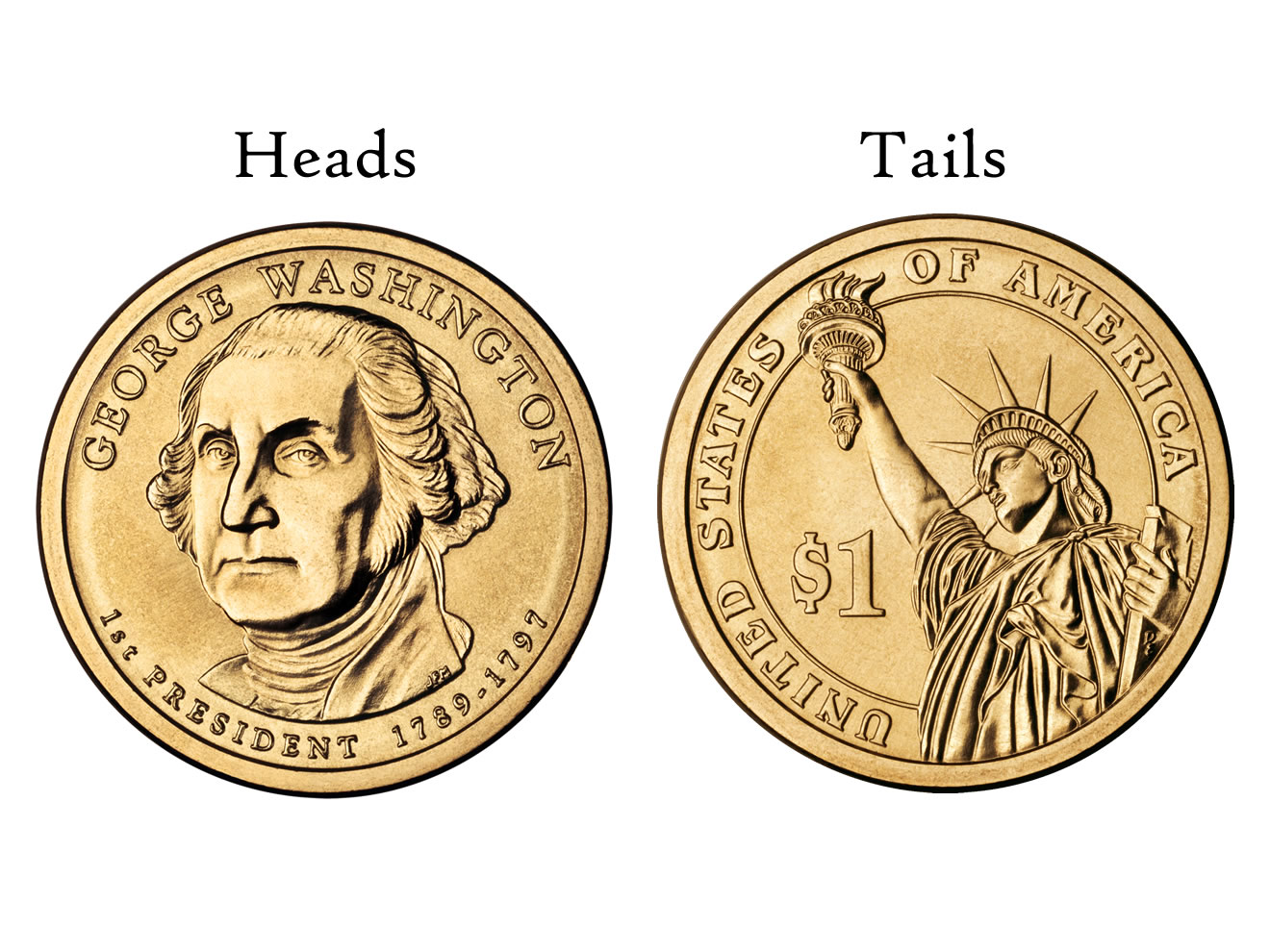
Grab a coin right now and feel it. Real coins are not perfectly symmetric: the two faces carry different designs, and the rim and edge are not perfectly uniform. An airborne flip barely notices any of this — but a coin spun on a flat surface can be strongly biased toward one side.
The classic example is the US penny: spun on its edge, it lands tails up far more often than heads up. The exact mechanism is debated — analyses point to the shape of the rim and edge at least as much as the weight of the portrait — but the spin bias itself is well documented. To reduce this bias, make sure to catch the coin since it will most likely spin if you let it hit the ground.
Either way, keep in mind that a greater tendency towards tails does not mean that the coin will always land tails up!
It’s one of the most-asked questions about coin bias. For a U.S. quarter the honest answer is: no one has reliably measured a meaningful weight difference between the two faces — whatever difference exists is tiny.
Does it matter? Only if you spin the coin. Like the penny above, a spun quarter can drift toward one side. In a normal airborne flip that you catch, the difference is far too small to measure: across 350,757 recorded flips, researchers found no heads-versus-tails bias at all — the only real effect was the 50.8% same-side tendency.
So if someone insists on spinning a quarter instead of flipping it, now you know why. Want to try one with no physics involved? Flip a virtual quarter.

Did a magician just challenge you to a coin toss? If you ever find yourself in a situation involving a coin toss with a magician, always be careful.
Trick coins can be shaved or weighted so that one side is favored. This means that such coins are heavily biased towards landing with the lighter side up. They could also trick you into thinking that the coin is flipping when it’s actually spinning. In this situation, make sure to use a coin that hasn’t been tampered with!

As much as you can take advantage of certain biases, they can also work against you. Therefore, it may be better to try to reduce them altogether. Here are some small things you can keep in mind before a coin toss.

If you're calling someone else's toss, the best evidence says: call the side that's facing up before the flip. That's the 50.8% win rate measured across 350,757 real flips — small, but it's the only legitimate edge there is.
If you're the one flipping and you want the fairest possible result:
And remember: even with that 50.8% win rate, you'll still lose nearly half the time. A single flip is still, for any practical purpose, a coin flip. Curious how the odds behave in bulk? Flip a coin 100 times and watch the split settle toward 50/50.
Want a toss with no thumb, no wind, and no shaved edges — just a cryptographically fair 50/50? Flip a coin online now.
Share this link via






Or copy link