
Share this link via
Or copy link
Bet The Flip (β)
Your current points are 10.
Current win streak: 2
Win streak bonus: x1.5
Which one will you bet on?
How much would you like to bet?
You're betting 3 points on heads.
If you're ready, please tap the button below, and flip your coin!
Result
You Win! You've earned points!
Current points: 10
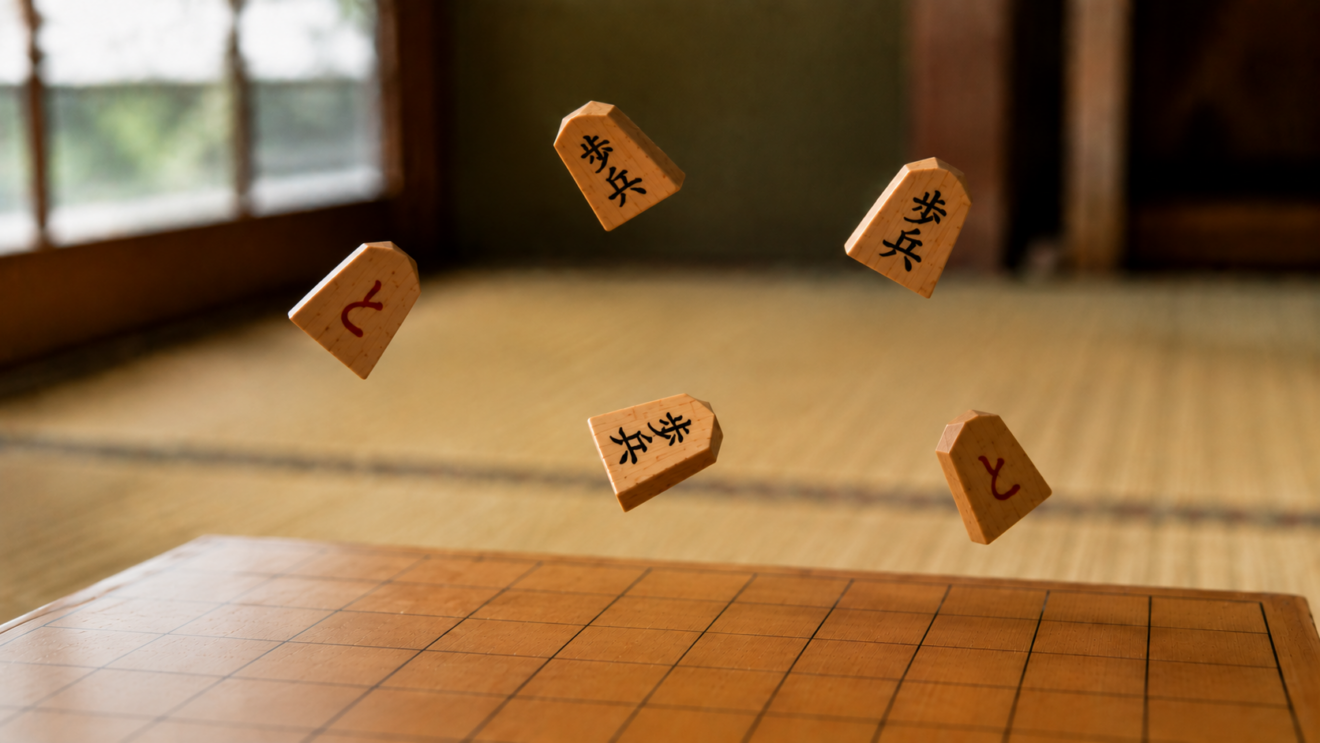
Before two shogi players move a single piece, one of them is going to scoop up five pawns, cup them between their palms, and let them rattle onto the board. The result decides who plays first — and at the professional level, that first move is worth a measurable edge: roughly 52 to 53 wins out of every 100 games. The ritual is called furigoma ("pawn toss"). Outside Japan, almost no one has heard of it.
Here is how it works, where it came from, and what the data says about whether either side has an edge.
Shogi is the Japanese cousin of chess. The boards look different, the pieces look different, and captured pieces can be returned to the board — but the opening question is the same one chess players settle with the color of the pieces: who moves first? In shogi, the first move belongs to the sente ("leading hand"), and the answering player is the gote ("following hand"). The sente advantage is real but small, and furigoma is the random ritual that assigns it.
Shogi pieces are flat wooden wedges, each with two faces. The unpromoted face of a pawn is called fu, and the promoted face is called tokin. Furigoma uses five pawns and treats the two faces as a binary outcome: fu-up versus tokin-up. The side with more fu wins for one player; more tokin wins for the other.
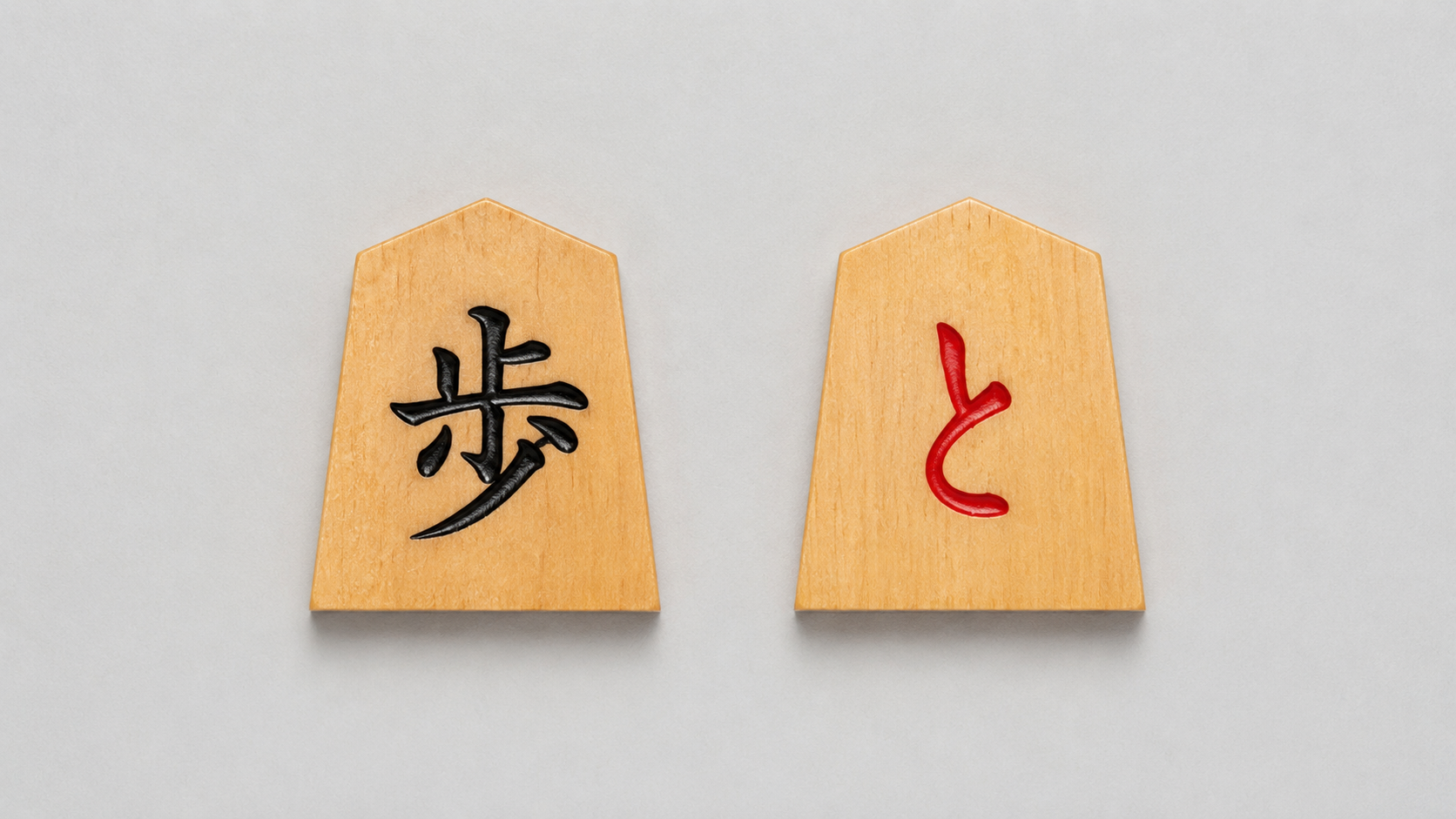
The two faces of a shogi pawn used in furigoma. The unpromoted side, fu (歩), is carved in black; flip the piece over and the promoted side, tokin (と), appears in cursive script — red on many everyday sets like this one, black lacquer on traditional carved pieces. These two faces serve the same role as heads and tails on a coin.
Furigoma is performed on behalf of the superior player. In official tournaments that means the higher-ranked competitor. In casual games it can mean the older, more experienced, or higher-status player — local custom decides. The fu side always represents that superior player, and the tokin side represents the other player. After the toss, whichever side comes up more often becomes sente.
This rule isn't a courtesy — it has a practical reason. The convention removes ambiguity about which face means what. In professional matches the toss is performed by the official recorder (kirokugakari) using the senior player's own pawns; the senior player rarely touches the pieces during the toss itself. The mapping of faces to players is the same in casual and tournament play.
The procedure is short and surprisingly strict.
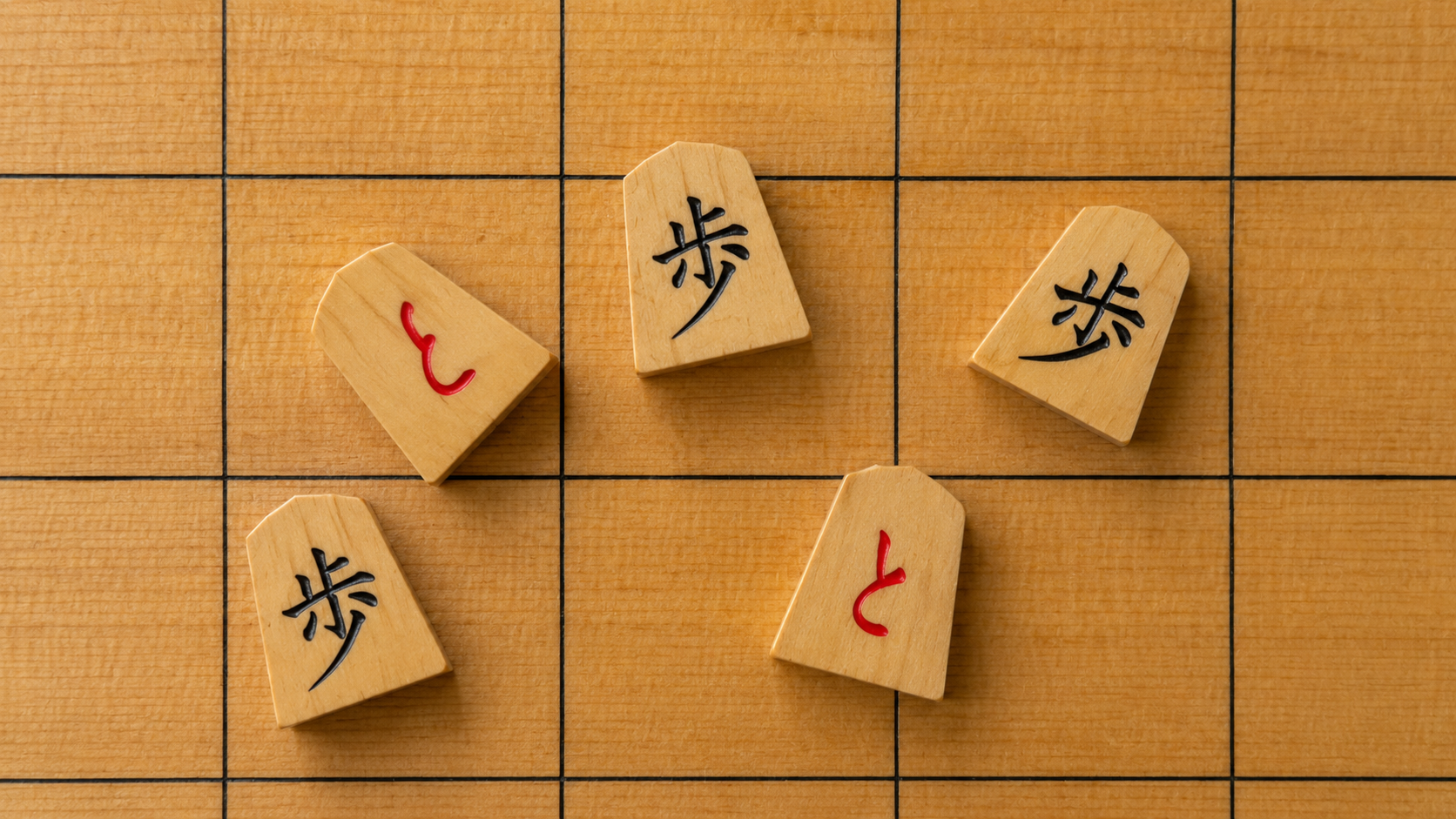
A completed furigoma toss. Three pieces have landed fu-up (歩) and two tokin-up (と) — the fu side wins by a 3-to-2 margin, so the superior player becomes sente and plays the opening move.
Wooden pieces don't always cooperate. If one of the five pawns lands on its side, you simply exclude it from the count and decide the result from the remaining four. The stacking case is trickier and conventions vary: the most common reading is that two pieces resting on top of each other are both excluded, leaving three to be counted; some local rules instead exclude only the piece on top and count the one beneath it. If a piece lands on top of an unrelated object — not one of the other tossed pawns — it is counted normally.
If the surviving count ties (two-and-two after one piece is excluded, for example), the toss is performed again with all five pieces. There is no rule about re-rolling individual pieces; it's all five or nothing.
You might suspect the toss isn't perfectly 50/50. Pawns aren't symmetric coins — the front and back faces have different carvings, and the wood grain runs along the piece. In July 2005 the Japan Shogi Association began recording the result of every official-game furigoma in its game records, and the first twelve months of figures — published in its magazine Shogi World — answer the question.
Out of 1,541 official tosses, fu came up more often in 776 games (50.4%) and tokin came up more often in 765 games (49.6%). That's a difference of 11 games out of more than 1,500 — small enough to be consistent with pure chance. Statistically, you cannot reject the hypothesis that furigoma is a fair binary toss.
So while pawns aren't coins, the geometry works out: the toss is, for all practical purposes, fair.
Five pieces, rather than two or four or six, is a deliberate choice. An odd count means the toss can almost always be settled in a single throw — there is no even split between fu and tokin to argue over. A single pawn — being a flat, asymmetric wooden wedge — would not be a fair binary randomizer the way a minted coin is, and any even number of pieces reintroduces the possibility of a tie. Five strikes the balance: enough pieces to absorb the asymmetry of a single piece, but odd enough to produce a clean winner.
The 1,541-toss dataset bears this out: a wooden, hand-tossed ritual that produces a binary outcome statistically indistinguishable from a fair coin.
Furigoma wasn't always done with five pawns. According to the most widely cited account, the practice traces back to an Edo-period match between Itō Sōkan I, the first head of the established Itō shogi family, and Higaki Zean, an unaffiliated challenger from outside the three official shogi houses. The game is remembered in Japanese shogi history as Zean toketsu no kyoku — "Zean's blood-vomiting game" — for its legendary intensity.
Before the Japan Shogi Association (founded 1924) standardized the modern rules, top players often played handicap games — games where the stronger side started with one or more of their own pieces removed to even the contest. The Itō–Zean match was one of these — planned as a two-game set with one bishop-handicap game and one lance-handicap game — and the two players reportedly couldn’t agree on which of the two games should be played first.
According to the prevailing account among shogi researchers, the players settled the dispute by tossing a spare pawn from outside the game — fu-up meaning one order of games, tokin-up the other. No official records of the match survive, so the toss is part folklore, part educated reconstruction; researchers favor the single-pawn version because taking a spare pawn from the piece bag would have been more natural than removing pieces from the active board. The core point, however, is well established: furigoma began as a coin-flip substitute when two stubborn players needed an answer.
When the five-pawn version we use today became standard is also not precisely documented. The JSA standardized many points of game etiquette around the time of its founding and renaming. By the establishment of the Meijin tournament in 1935, the five-pawn count was already in place. Top-level professional tournaments no longer use handicaps, so furigoma now only decides who moves first — but the procedure itself is a direct descendant of a single tossed piece nearly four centuries old.
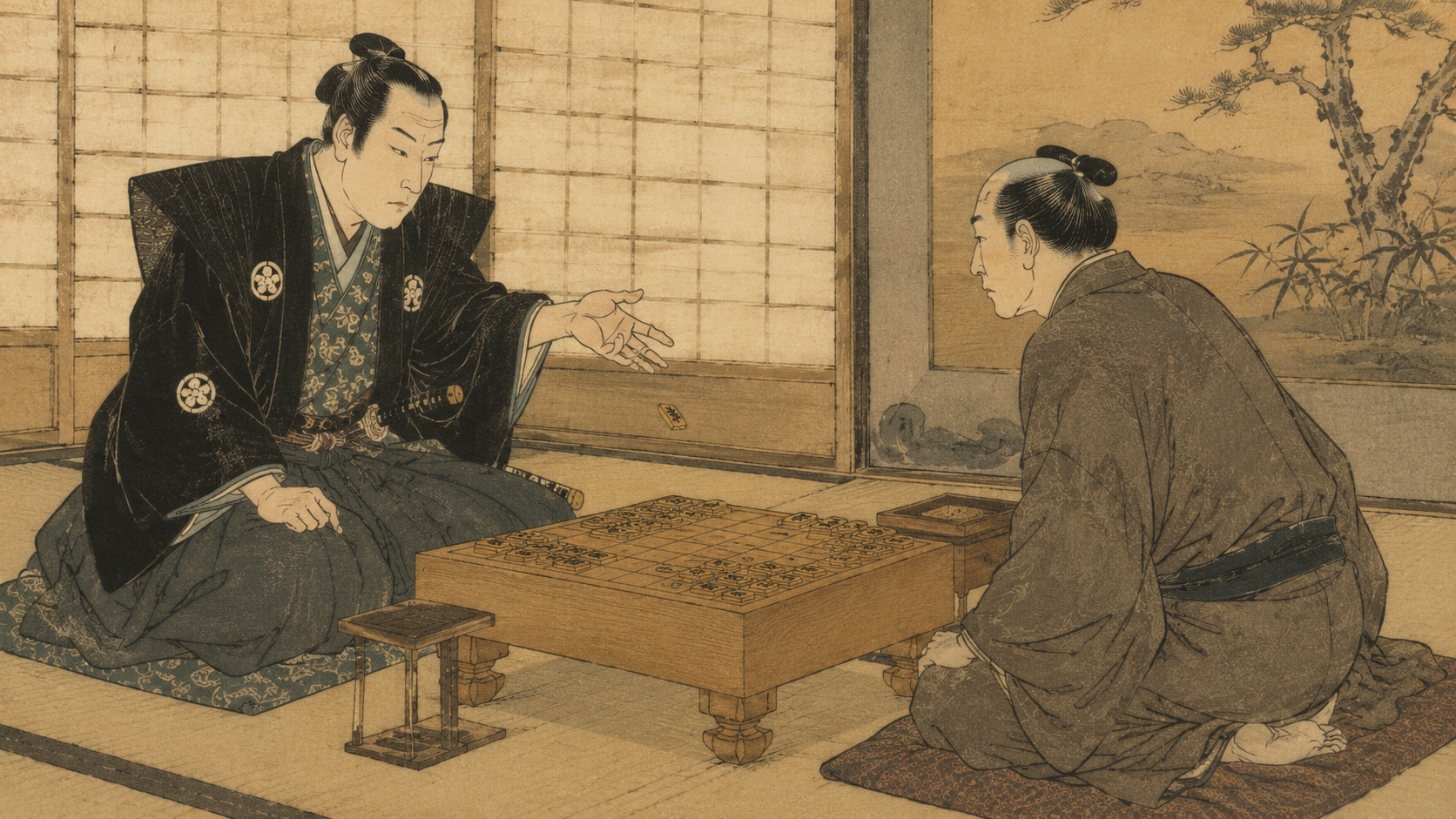
An Edo-style depiction of a high-stakes shogi match, evoking the legendary Zean toketsu no kyoku — the 17th-century game between Itō Sōkan I and Higaki Zean that, by tradition, gave birth to furigoma when the two players could not agree on the handicap.
It does. The Japan Shogi Association's own statistics show the sente player winning around 52 to 53 percent of professional games — a figure that has held steady across decades of record-keeping. That's not a crushing advantage, but it is statistically real, comparable in size to White's edge in chess (roughly a 54 percent scoring rate in top-level play).
If a single move is worth two to three percentage points, then a single random toss is worth a measurable amount of expected result. That's why the toss matters enough to have its own choreography, its own etiquette, and four hundred years of tradition.
For more on how a small ritual at the start of a game can shape its outcome, see our companion article on seven famous coin tosses that changed sports history.
If you don't have five shogi pawns handy, the simplest substitute is the one that has been settling first-moves and sides for two millennia: a single coin. Flip a virtual coin when you need to decide who goes first — at the chessboard, the shogi board, or anywhere else. It's the same 50/50 the 17th-century players who first improvised the toss were hunting for, just rendered in pixels instead of pine. (Curious how that 50/50 came to be a universal tiebreaker? See our piece on the history of coin flipping.)
Share this link via






Or copy link